
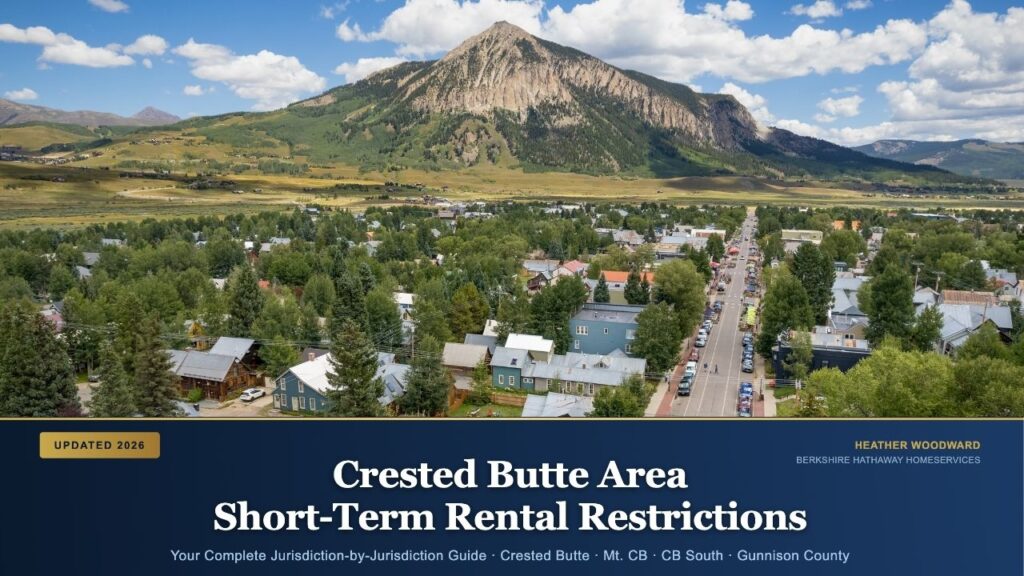

If you’re considering buying, selling, or investing in property in the Crested Butte and Gunnison Valley area, understanding short-term rental (STR) regulations is no longer optional, it’s essential. The landscape has shifted significantly heading into 2026, with Gunnison County rolling out a brand-new licensing program and Colorado introducing new statewide tax classification rules for STR properties. Whether you’re dreaming of a mountain retreat that pays for itself or evaluating a full investment property, this guide breaks down everything you need to know jurisdiction by jurisdiction.
What’s New in 2026: Colorado’s STR Property Tax Classification
A significant statewide change took effect in January 2026. Under Colorado Senate Bill 24-33, short-term rental units that are not primary residences and are rented for less than 30 days at a time for more than 90 days in the prior tax year are now classified as lodging properties for property tax purposes. This is a meaningful shift that can affect your tax bill and investment calculations.
Key Points of the New State Law
- Assessors will notify STR owners of the number of qualifying rental days recorded in the prior tax year.
- Owners must sign and return the notice, or provide evidence to dispute the classification.
- The state is building a pilot program for a statewide STR database and uniform reporting system.
TOWN OF CRESTED BUTTE
The Town of Crested Butte has some of the most restrictive STR rules in the valley, reflecting its commitment to preserving neighborhood character and long-term housing availability.
License Types
- Primary Occupancy License: For owner-operators who live in the unit for six months or more per year. More attainable but comes with occupancy requirements.
- Unlimited License: For non-owner-occupied properties. These are capped by ordinance supply is limited and licenses are difficult to obtain.
Key Rules & Requirements
- A Business Occupation License is required for all STR operators in addition to the vacation rental license.
- Properties in certain residential zones may be ineligible for vacation rental licenses altogether always verify zoning before purchasing.
- Long-term rental deed restrictions on accessory dwelling units (ADUs) are permanent and cannot be converted to STRs. This is a common surprise for buyers ask your agent before assuming an ADU can generate short-term income.
- Operators must collect and remit excise taxes, sales tax, and applicable local and state taxes.
TOWN OF MT. CRESTED BUTTE
With ski-in/ski-out access and a resort-focused atmosphere, Mt. Crested Butte is the most STR-friendly jurisdiction in the valley, and a popular choice for investors. The licensing program has been in place since 2020 and is well-established.
Key Facts
- No cap on the number of STR licenses and no zoning restrictions on STRs. A significant advantage for investors compared to other area jurisdictions.
- Any property rented for 29 nights or less requires a current, valid STR license issued by the Town.
- License fee: $400 per property, valid through the calendar year (not 12 months from issue date). Renewal applications must be submitted 60 days before expiration.
- Each property requires its own license, you cannot STR more than one unit under a single license.
- The STR license number must be posted visibly at the property AND included in all online advertisements (Airbnb, VRBO, etc.). Failure to display in ads results in a $200 fine.
- A Local Representative must be named, must live within 45 minutes of Mt. Crested Butte, must be reachable 24/7, and any change must be reported to the Town within 10 days.
Taxes
- Airbnb collects and remits all taxes directly to the Town of Mt. Crested Butte.
- VRBO remits taxes only for non-integrated listings. If you use property management software integrated with VRBO, you are responsible for monthly remittance,
- Booking.com and other platforms: you are fully responsible for all tax remittance.
- Tax rate: 5% retail sales tax + 4.9% excise tax on gross short-term rents. Late payment penalty: $15 or 10% of deficiency, whichever is greater.
CRESTED BUTTE SOUTH (CB SOUTH)
Crested Butte South is governed by the Crested Butte South Property Owners Association (POA), not a municipality. Its STR policy, last updated in July 2024, emphasizes community impact and primary residence status.
Key Rules
- A Short-Term Rental License from the CB South POA is required for any rental of 29 consecutive days or less.
- License term runs January 1 – December 31. Renewal applications must be received and paid by December 15 for the following year.
- A designated responsible party physically located in Gunnison County must be available 24/7 and able to respond on-site within 60 minutes to any issues.
- Maximum occupancy: 2 persons per bedroom + 2 additional occupants. Exceeding this limit results in license revocation.
- Parking is limited to the spaces shown on the original building plan, no overflow parking permitted.
- Owners are responsible for their guests’ compliance with all POA rules. Guest violations can result in fines to the owner and immediate termination of the rental agreement.
- Operating without a license: $400 fine after a 30-day correction notice.
GUNNISON COUNTY – MAJOR CHANGES IN 2026
This is the jurisdiction with the most significant news heading into 2026. Unincorporated Gunnison County which includes rural areas, properties along the Taylor River corridor, and areas outside town limits is launching a new mandatory STR licensing program.
What’s Changing
- The new mandatory licensing program focuses primarily on accountability and tax collection for the Local Marketing District (LMD) not heavy regulation but compliance is required.
- License fee: $150, valid for 3 years. Renewal is available 60 days before expiration.
- The program gives the County visibility into total STR inventory how many exist, where, and whether applicable taxes are being paid.
- Future regulation (wildland-urban interface compliance, insurance requirements) remains a possibility but has not yet been adopted.
Existing Tax Requirements (Still in Effect)
- A 4% Gunnison County Local Marketing District Tax applies to all short-term lodging (rentals under 30 days). Remitted quarterly on Form DR 1490.
- Residential STR properties retain their residential property tax assessment rate they do not convert to commercial rates unless exclusively rented with no owner’s quarters.
- Any property rented for profit, regardless of duration, is subject to personal property taxes.
CITY OF GUNNISON
The City of Gunnison requires all short-term rental (STR) properties to be licensed through the city’s finance department, where applicable lodging and sales taxes are collected. STRs are generally defined as rentals of 30 days or less.
- STR licenses are required for all properties rented for 30 days or less.
- Applicable lodging (hotel) and sales taxes must be collected and remitted.
- Primary residence STRs and, in some cases, accessory dwelling units (ADUs) may be permitted depending on zoning.
- A local responsible party must be designated and available to respond to issues or complaints.
- The city is actively evaluating additional regulations, including potential limits on non-primary residence STRs, ownership duration requirements, and possible caps on the total number of STR licenses.
Bottom line: Gunnison is taking a thoughtful and evolving approach to managing STR growth while working to preserve long-term housing. Because regulations and proposals may change, buyers and investors should stay informed on current ordinances and policy updates.
Quick Reference: STR Regulations by Jurisdiction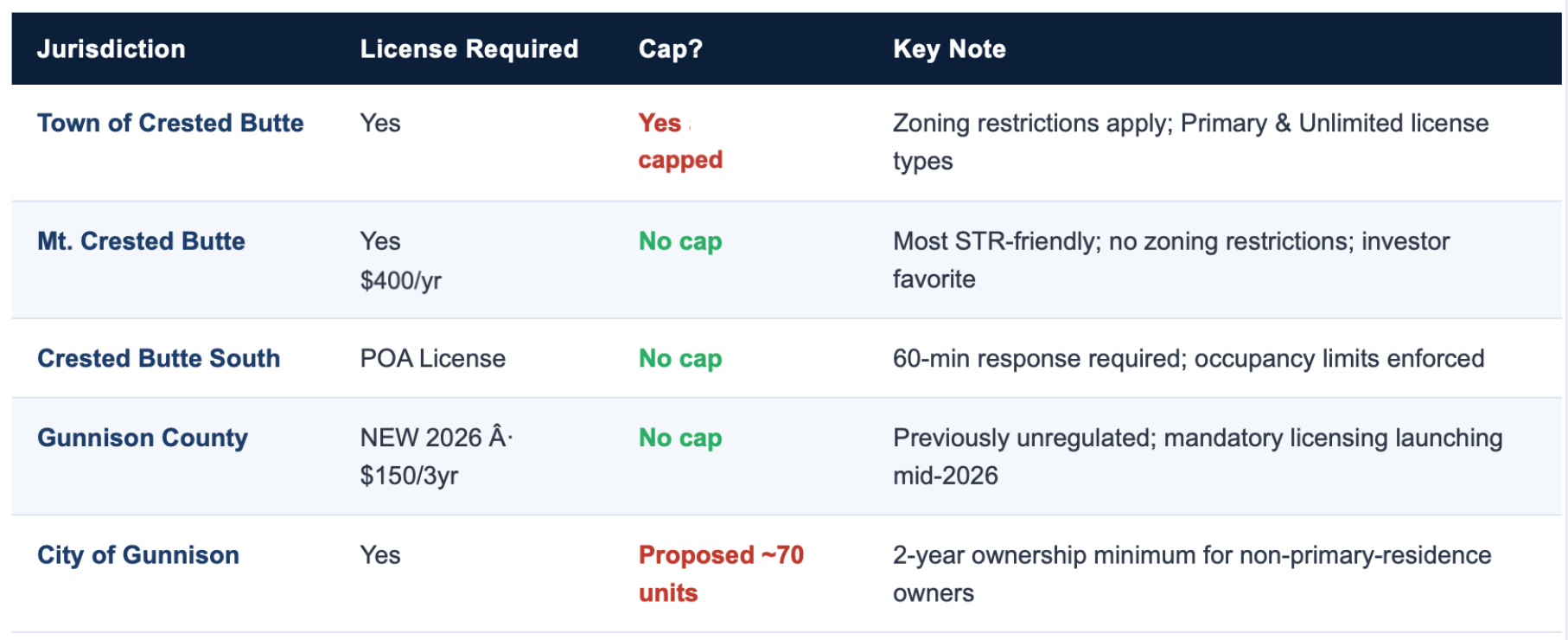

SHORT-TERM RENTALS DOCUMENTS & WEBSITE LINKS:
Crested Butte STR Regs
CB South STR Regs Final
Mt CB STR Regs Final
Gunnison County
CHECK OUT THE VIDEO BELOW FOR A MOTE IN-DEPTH LOOK AT THIS TOPIC:

Let’s Navigate This Together
Short-term rental regulations in the Crested Butte and Gunnison area are genuinely complex and they’re evolving. What worked for a property two years ago may not apply today, and what’s true in one neighborhood may be completely different two miles away.
Whether you’re buying a mountain retreat and hoping to offset costs with occasional rentals, or evaluating a full-scale investment property, I’m here to help you understand the rules, run the real numbers, and make a confident decision.